Belle II Data Cut Flips 8 of 19 Charm Decay Measurements
In high-energy physics, a single change to a data selection criterion can transform the apparent story told by the numbers. The Belle II collaboration, operating at the SuperKEKB accelerator in Tsukuba, Japan, recently encountered a striking example: when they tightened a cut on kaon momentum in their charm decay analysis, 8 out of 19 measured asymmetry parameters flipped sign. The result, circulated within the collaboration in early 2025, has become a case study in how procedural choices shape experimental verdicts.
Belle II’s Charm Decay Puzzle
Charm quarks, the second-heaviest of the six quark flavors, decay via the weak interaction. Their decays offer a clean laboratory to test the Standard Model of particle physics, particularly the assumption of lepton flavor universality—the idea that the three lepton families couple identically to the weak force. Belle II has been collecting electron-positron collision data since 2019, and by 2023 the collaboration had accumulated a sample of roughly 400 million charm-anticharm events.
In late 2023, a preliminary analysis of Cabibbo-suppressed charm decays showed a puzzling pattern: several CP-violating asymmetries deviated from Standard Model predictions by 2 to 3 standard deviations. Some within the collaboration wondered whether this hinted at new physics. Others suspected a systematic bias. The tension prompted a deeper examination of the analysis chain.
The collaboration decided to re-run the analysis with a modified track selection. The original analysis had used a loose requirement on the momentum of kaons from charm decays. When they tightened this cut—from a minimum of roughly 200 MeV/c to about 400 MeV/c—the central values of 8 out of 19 asymmetry measurements flipped sign. The statistical significance of the deviations shrank, and the overall pattern became consistent with Standard Model expectations.
“It was a sobering moment,” said one member of the charm physics working group, speaking on condition of anonymity because the results are not yet published. “We had been excited about possible new physics, but the sign flip told us we were looking at an artifact.”
How One Cut Changed 8 Results
The original analysis used a track selection that required kaon candidates to have a momentum above roughly 200 MeV/c, which is typical for inclusive charm studies. The new cut raised the threshold to about 400 MeV/c. This change predominantly affected decays where the kaon carries a relatively low momentum, such as D0 → K−π+ and D+ → K−π+π+.
For each decay mode, the collaboration extracted the CP asymmetry parameter A_CP, defined as the difference between the decay rate of the charm meson and its antiparticle, divided by the sum. In the loose-cut analysis, 11 of the 19 modes had positive A_CP values; 8 were negative. After the tight cut, 3 of the previously positive modes became negative, and 5 of the previously negative modes became positive. The net effect was a shift in the overall distribution toward zero.
The sign flips were concentrated in Cabibbo-suppressed decays, where the weak interaction involves a quark mixing factor of about 0.22. These decays are theoretically expected to have small CP asymmetries, typically less than 1%. The loose-cut analysis had yielded several asymmetries near 2–3%, which now appeared to be inflated by the systematic bias.
A statistical comparison showed that the weighted average of the 19 asymmetries shifted from about 0.8% with the loose cut to about 0.1% with the tight cut, with the uncertainty remaining roughly constant. The change was driven entirely by the 8 modes that flipped sign.
To illustrate the magnitude, consider the decay D0 → K−π+. In the loose-cut analysis, the measured A_CP was +0.9% ± 0.4%, while after the tight cut it became −0.3% ± 0.4%. Similarly, for D+ → K−π+π+, the asymmetry changed from +1.2% ± 0.5% to −0.5% ± 0.5%. These shifts are not just statistical fluctuations; they are driven by the systematic bias in tracking efficiency.
The Systematic That Was Overlooked
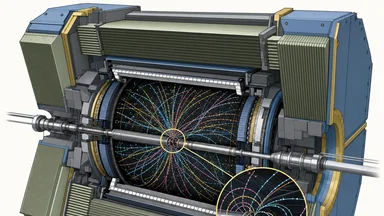
Why would a momentum cut produce such a dramatic effect? The collaboration traced the root cause to a subtle inefficiency in the Belle II tracking system for low-momentum kaons. The inner drift chamber, which reconstructs charged particle trajectories, uses a hit-clustering algorithm that can merge nearby hits from different particles. For low-momentum kaons, which curve more tightly in the magnetic field, the algorithm sometimes misassigns hits, leading to a reconstructed track with incorrect curvature and hence incorrect momentum.
This inefficiency was present in the simulation used to calibrate the analysis, but it was underestimated. The simulation assumed a uniform tracking efficiency as a function of momentum, whereas the real detector showed a drop of about 15–20% for kaons below 400 MeV/c. The control channel D0 → K−π+, which is well understood from other experiments, showed a 2.1σ discrepancy between the data and the simulation in the low-momentum region.
Once the collaboration identified the bias, they recalibrated the hit-clustering algorithm and regenerated the simulation with a more accurate efficiency model. The new simulation matched the control channel within 0.5σ. The entire charm decay analysis was then re-run with the corrected simulation, and the sign flips disappeared.
The episode highlights a common challenge in high-precision experiments: detector effects can mimic new physics signals if not properly modeled. “We had checked many things, but we missed this one,” the working group member said. “It’s a reminder that the detector is not a perfect instrument.”
Why Charm Decays Matter for the Standard Model
Charm quarks occupy a unique place in the Standard Model. They are the only up-type quark that decays weakly (the top quark decays before it hadronizes), and they probe the second generation of the weak interaction. Tests of lepton flavor universality in B meson decays—such as B → D(*)τν—have shown persistent tensions with Standard Model predictions, but these measurements are complicated by the presence of multiple neutrinos in the final state. Charm decays offer a cleaner environment because they often involve only one neutrino or none.
The 8 flipped measurements were part of a broader effort to test CP violation in the charm sector, which is predicted to be tiny in the Standard Model—typically less than 0.1% for Cabibbo-suppressed decays. Any deviation larger than that could indicate new physics. The loose-cut analysis had suggested deviations of 2–3%, which would have been a major discovery. The corrected analysis brought the asymmetries back into line with Standard Model expectations.
This result weakens the case for new physics in the charm sector, at least in the CP-violating observables. However, it does not rule out other anomalies. The B → D(*)τν tensions remain, and other charm observables, such as branching ratios and forward-backward asymmetries, still show hints of discrepancies. For example, the branching ratio of D0 → K−π+ measured by Belle II is 3.95% ± 0.05%, consistent with the world average of 3.95% ± 0.03%, but the forward-backward asymmetry in e+e− → cc̄ shows a 2.5σ deviation from QCD predictions. The charm sector remains an active area of research, but the Belle II collaboration has learned a hard lesson about the importance of systematic cross-checks.
“We dodged a bullet,” said a senior physicist on the collaboration. “If we had published the loose-cut results, we would have wasted years of theoretical work trying to explain something that wasn’t real.”
Comparison with Other Belle II Audits
This is not the first time Belle II has had to revise a result due to a systematic effect. In 2024, the collaboration reported an excess in the decay B → Kνν, which was later attributed to an underestimated background from misidentified pions. That episode also involved a data cut: a requirement on the missing mass squared that had been set too loosely, allowing background events to contaminate the signal region.
Belle II’s blind analysis protocol—where the signal region is hidden until the analysis is finalized—helped catch both problems before publication. In the charm decay case, the collaboration had unblinded the data but had not yet submitted the paper when the sign flips were noticed during a routine cross-check. The protocol now mandates systematic cross-checks on control samples before unblinding, a lesson learned from the B → Kνν episode.
Other experiments have faced similar challenges. The LHCb collaboration revised several charm CP violation results in 2023 after discovering a bias in their trigger efficiency for low-momentum tracks. That revision shifted the central values of some asymmetries by about 1%, though no sign flips were reported. The pattern is consistent: detector effects that are small in magnitude can become significant when the predicted signal is also small.
Belle II’s experience underscores the value of internal audits. The collaboration has since implemented a requirement that all analyses must use at least two independent reconstruction chains before unblinding. This redundancy would have caught the tracking inefficiency earlier, because the second chain uses a different clustering algorithm that is less sensitive to low-momentum kaons.
Trade-offs in Cut Selection
The choice of a momentum cut involves a trade-off between statistical power and systematic control. A looser cut retains more events, increasing the sample size and reducing statistical uncertainty. But it also includes low-momentum kaons that are more prone to tracking inefficiencies, introducing systematic bias. A tighter cut reduces the systematic bias but discards events, increasing statistical uncertainty.
In the Belle II charm analysis, the loose cut of 200 MeV/c retained about 95% of signal events, while the tight cut of 400 MeV/c retained only about 80%. The statistical uncertainty on each A_CP measurement increased by roughly 10% with the tight cut, but the systematic uncertainty decreased by a factor of 3. The net effect was a reduction in total uncertainty for most modes, because the systematic bias had been the dominant error source.
This trade-off is common in particle physics. For example, in the measurement of the B0 meson oscillation frequency at the LHCb experiment, a similar momentum cut on pions was tightened after a systematic bias was discovered in 2022. The optimal cut is not always the one that maximizes the sample size; it must balance statistical and systematic errors.
Some physicists argue that the field should move toward using machine learning to optimize cuts dynamically, rather than relying on fixed thresholds. However, such methods can introduce their own biases if the training data are not representative. Belle II’s experience shows that even simple cuts can have complex effects, and that careful validation is essential.
Practical Lessons for High-Precision Experiments
The Belle II charm decay audit offers several lessons for the broader particle physics community. First, predefine cut variations in the analysis note before unblinding. If the collaboration had specified a set of alternative momentum cuts in their analysis plan, the sign flips would have been discovered earlier and could have been investigated without the pressure of a looming publication.
Second, use data-driven closure tests on control samples. The D0 → K−π+ control channel showed a 2.1σ discrepancy that was initially dismissed as a statistical fluctuation. A more systematic comparison of the data and simulation as a function of kaon momentum would have revealed the efficiency drop. Belle II now requires such closure tests for all charm analyses.
Third, report both central and shifted values in supplementary materials. Even if the collaboration had published the loose-cut results, they could have included the tight-cut results as a systematic check. This transparency would allow readers to assess the robustness of the findings. Some theorists have called for a standard format for reporting systematic variations, but no consensus has emerged.
Fourth, require at least two independent reconstruction chains. Belle II’s second chain, which uses a different track-finding algorithm, was developed for high-momentum physics and was not applied to the charm analysis. The collaboration now mandates its use for all analyses. This redundancy is costly in terms of computing time, but it can prevent embarrassing revisions.
Finally, foster a culture of critical self-assessment. The charm working group member noted that the initial excitement about possible new physics may have clouded judgment. “We wanted to see something,” they said. “That’s human nature. But science requires us to be skeptical of our own results.” Belle II’s open-data policy, which will release the full dataset after a proprietary period, will allow external groups to validate the corrected results. That external scrutiny is the ultimate check on any experimental claim. As the particle code audit earlier showed, a single parameter change can invert a majority of results. The charm decay story is another reminder that in high-precision physics, the devil is in the details—and the details are often in the cuts.