Brenda Milner's Single Case Study Rewired Memory Circuit Maps
In 1953, a 27-year-old man known as H.M. underwent experimental brain surgery to control severe epilepsy. The surgeon, William Scoville, removed the medial temporal lobes on both sides, including most of the hippocampus and surrounding cortex. The operation stopped the seizures but left H.M. unable to form new conscious memories. He could not remember what he had for breakfast or who visited him minutes earlier. Yet when Brenda Milner, a young psychologist from the Montreal Neurological Institute, began testing him in 1955, she discovered something unexpected: H.M. could learn new motor skills, even though he had no recollection of practicing them. That dissociation — between knowing how and knowing that — became the cornerstone of modern memory research.
The Patient Who Forgot Her Surgeon
Scoville's procedure, a bilateral medial temporal lobectomy, was radical even by the standards of the time. He removed roughly 8 centimeters of tissue from each hemisphere, taking out the amygdala, the entorhinal cortex, and about two-thirds of the hippocampus. The goal was to excise the epileptic focus, but the outcome was a profound anterograde amnesia: H.M. could hold a conversation but would forget it moments later if distracted. His short-term memory span, measured by digit repetition, was normal — about seven items — but nothing transferred to long-term storage.
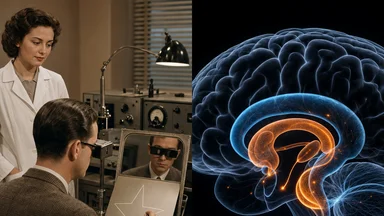
Milner first met H.M. in 1955, two years after the surgery. She administered a battery of neuropsychological tests, many adapted from her doctoral work with Donald Hebb at McGill University. One task involved mirror tracing: H.M. had to trace a star-shaped outline while looking only at its reflection in a mirror. The task is awkward and error-prone on the first try. But over several days of practice, H.M.'s performance improved steadily. He made fewer errors and completed the tracing faster. Yet each day he denied ever having done the task before. Milner later described the moment as a "scientific shock" — here was clear evidence of learning without awareness. That result contradicted the prevailing view that memory was a unitary faculty, damaged or intact as a whole. H.M. could not recall the mirror-tracing sessions, but his motor system had encoded the skill. Milner recognized that the medial temporal lobes were not the seat of all memory, but specifically critical for forming new declarative memories — facts and events that can be consciously recalled. Procedural memories, such as motor skills and habits, depended on other brain structures. The dissociation was clean and reproducible, and it demanded a new model of how memory circuits are organized.
Milner's relationship with H.M. spanned decades. She tested him repeatedly, always introducing herself anew. He became the most studied patient in the history of neuroscience. The trust that developed between them allowed Milner to design experiments that pushed the limits of his spared capacities. She never treated him as a mere data source; she listened to his frustrations, his calm acceptance of his condition, and his occasional humor. That human dimension, combined with meticulous experimental control, made the single-case study a template for cognitive neuroscience.
Milner's Paradigm Shift from Lesion Mapping to System Dynamics
Before Milner, the dominant method in behavioral neuroscience was lesion mapping: damage a region in an animal, observe which behavior disappears, and infer that the region is necessary for that behavior. The approach worked well for sensory and motor systems but struggled with complex cognitive functions like memory, where damage often produced subtle or transient deficits. Human lesion studies were rare and usually confounded by variable lesion size and location. The field needed a way to ask not just where memory lives, but how memory systems interact.
Milner's innovation was to design tasks that could dissociate different memory processes within the same individual. The mirror-tracing task separated motor skill acquisition from conscious recall. She also used a version of the Gollin figures test, where subjects identify increasingly complete line drawings of objects. H.M. could identify fragmented figures faster after repeated exposure, even though he had no memory of seeing them. That implicit perceptual learning, like the mirror tracing, showed spared plasticity outside the medial temporal lobes. By demonstrating that one memory system could function independently of another, Milner shifted the focus from static maps to dynamic circuits. The hippocampus was not a memory storehouse but a structure critical for consolidating new declarative memories. Older memories, once consolidated, could be retrieved without hippocampal involvement — a finding that predicted the systems consolidation theory later elaborated by Larry Squire and others. The dissociation also implied that different brain regions support different memory types: the striatum for habits, the cerebellum for motor learning, the amygdala for emotional memory. Milner's case study provided the first clear evidence for this distributed architecture.
The implications were not immediately embraced. Some researchers argued that H.M.'s spared learning was an artifact of residual hippocampal tissue or that the tasks tapped non-mnemonic processes. Milner responded by varying the tasks systematically. She showed that H.M. could learn a mirror-reading skill but could not remember the specific words he had read. She demonstrated that his priming effects were normal, but his recognition memory was at chance. Each experiment tightened the dissociation, forcing critics to acknowledge that memory is not monolithic. By the early 1980s, the idea of multiple memory systems was widely accepted, and Milner's single case had become a cornerstone of cognitive neuroscience.
Single-Case Methodology as a Precision Instrument
Milner's choice to study a single patient intensively was not a compromise but a deliberate methodological strategy. Group studies average across individuals, which can obscure dissociations that exist in a subset of subjects. A single case allows the researcher to control for all idiosyncratic factors — age, education, motivation, lesion anatomy — and to repeat measurements until the pattern is reliable. Milner's background with Hebb, who championed the study of individual differences, shaped her approach. She saw H.M. not as a representative of a population but as a unique window into a functional architecture.
The mirror-tracing experiment, for example, involved multiple trials over several days. Each session began with a fresh set of instructions, and H.M. would express surprise at being asked to trace a star. Yet his error rate dropped from about 30 per trial on the first day to roughly 10 by the third. The improvement was consistent across replications. Milner did not rely on statistical significance in the modern sense; she used effect size and replicability. The dissociation was so large that no group averaging was needed to see it.
Modern neuroscience has confirmed the validity of single-case logic. Functional MRI studies of patients with selective hippocampal lesions show the same pattern: spared procedural learning, impaired declarative memory. Lesion network mapping, a technique that uses resting-state connectivity to identify circuits affected by a focal lesion, relies on single-case data to generate hypotheses that are then tested in larger samples. The precision of Milner's behavioral measures — reaction times, error rates, savings scores — translates directly into the kind of parametric designs used in contemporary cognitive experiments.
The single-case approach has limitations. It cannot easily generalize to a population, and it is vulnerable to the idiosyncrasies of one brain. But Milner argued that a well-documented dissociation in one patient is more informative than a noisy correlation in a hundred. She was careful to replicate her findings across tasks and across sessions, and she later studied other patients with similar lesions to confirm the pattern. The balance between depth and breadth remains a tension in cognitive neuroscience today, but Milner showed that depth can yield discoveries that breadth misses.
The 1957 Paper That Redrew the Memory Circuit Map
In 1957, Scoville and Milner published "Loss of Recent Memory After Bilateral Hippocampal Lesions" in the Journal of Neurology, Neurosurgery & Psychiatry. The paper described H.M.'s amnesia and three other patients with less complete resections. It argued that the hippocampus is essential for the formation of new memories, while older memories, once consolidated, are stored elsewhere. The evidence was clear: H.M. could recall childhood events but could not remember a story told to him ten minutes earlier. The paper also noted that his intelligence, language, and perception were intact, narrowing the deficit to memory alone.
The paper was met with skepticism. The hippocampus had been linked to olfaction and emotion, not memory. Some researchers thought the amnesia was due to damage to the temporal stem or the amygdala. But Milner's careful behavioral data made the case hard to dismiss. Over the following decades, the paper accumulated more than 3,000 citations and became a foundational text for the taxonomy of memory systems. It established the distinction between declarative (explicit) and nondeclarative (implicit) memory, a framework that still organizes the field.
The paper also had a methodological impact. It showed that a single, well-characterized patient could provide evidence that group studies had missed. It encouraged other researchers to study patients with selective lesions — such as those with amnesia due to encephalitis or anoxia — and to develop tasks that could dissociate memory processes. The paper's influence extended beyond clinical neurology to experimental psychology, cognitive science, and artificial intelligence, where the idea of multiple memory systems inspired computational models of learning and memory.
One of the paper's most provocative findings was the preservation of remote memories. H.M. could recall events from before his surgery, including his childhood and early adult years. That suggested that the hippocampus is not the permanent repository of memories but a structure that facilitates their consolidation. Once memories are established in neocortical networks, the hippocampus becomes less critical. This systems consolidation view was later supported by animal studies showing that hippocampal lesions impair recent but not remote memories. The paper thus redrew the memory circuit map from a static store to a dynamic, time-dependent process.
From H.M. to Modern Connectomics: Methodological Legacy
The principles that Milner established — dissociation of functions, intensive single-case testing, parametric task design — now permeate cognitive neuroscience. Diffusion tractography, which maps white-matter pathways, has revealed the hippocampal-cortical connections that support consolidation. Resting-state functional connectivity studies show that the hippocampus is part of a default-mode network that is active during memory retrieval and future thinking. The dissociation between procedural and declarative memory guides the analysis of these networks: regions that co-activate during skill learning differ from those that co-activate during episodic recall.
Lesion network mapping, developed by Michael Fox and colleagues, applies the logic of Milner's single-case study to group data. By taking a focal lesion and mapping its connectivity to a normative connectome, researchers can identify the distributed network affected by the lesion. This approach has been used to map circuits for language, emotion, and consciousness. It directly extends Milner's insight that a lesion's behavioral effect depends not only on the damaged area but on the circuits it disconnects. The single-case logic is preserved: the lesion provides a natural experiment, and the behavioral deficit reveals the function of the disconnected network.
Milner's behavioral tasks have also been adapted for clinical assessment. The Rey-Osterrieth complex figure test, which she used to assess visuospatial memory in H.M., is still widely used. The Wechsler Memory Scale, developed after her work, includes subtests for immediate and delayed recall that mirror her experimental measures. The Montreal Cognitive Assessment, though not directly derived from her work, follows her emphasis on brief, sensitive tasks that can detect mild cognitive impairment. The practical legacy of her methodology is visible in every neuropsychological battery used today.
Yet the legacy is not uniformly positive. The dominance of group-based fMRI studies has sometimes led researchers to overlook single-case dissociations. Large datasets with hundreds of subjects can detect subtle effects, but they can also miss the kind of clean dissociation that Milner found. Cognitive neuroscientists like Bradley Postle at the University of Wisconsin–Madison and Russell Poldrack at Stanford University have argued that the field should return to intensive single-case testing, especially for rare neurological conditions. The tension between statistical power and experimental precision remains unresolved, but Milner's work shows that both approaches are necessary.
Practical Takeaways for Cognitive Neuroscience Today
Milner's career offers lessons for contemporary researchers. First, single-case designs are underutilized in fMRI research, where group averages dominate. A single patient with a well-characterized lesion can provide a causal test of a hypothesis that correlations cannot. Second, task design must separate processes, not just activate regions. Milner's mirror-tracing task was clever because it required learning without explicit instruction. Many modern fMRI tasks are too complex, mixing memory, attention, and decision-making in ways that obscure dissociations. Simpler, parametric tasks often yield cleaner results.
Third, null results can be informative. H.M.'s failure to remember the mirror-tracing sessions was as important as his success in learning the skill. Researchers should design experiments where a null result in one condition and a positive result in another can reveal a dissociation. Fourth, Milner's approach was iterative: she kept refining tasks until the dissociation emerged. That patience is rare in a field where grants typically last three years, but it is essential for building robust theories. As colleague Suzanne Corkin, who later studied H.M. at MIT, noted, Milner was willing to run the same experiment for years until she understood what it meant.
Finally, Milner's work reminds us that the brain is not a collection of independent modules but a set of interacting circuits. The hippocampus does not store memories alone; it works with neocortical regions, the striatum, and the cerebellum. Understanding those interactions requires both lesion studies and network analyses. The future of memory research likely lies in combining intensive single-case testing with circuit-level models, using tools like optogenetics to manipulate specific pathways in animal models and high-resolution fMRI to map their human analogs. Milner's single case study was not the end of the story but the beginning of a new way to ask questions about how the brain remembers.
One can trace a direct line from H.M.'s mirror tracing to modern studies of procedural learning in Parkinson's disease, where striatal dysfunction impairs habit formation. Similarly, the distinction between episodic and semantic memory, now a standard topic in textbooks, originates in Milner's observations of what H.M. could and could not recall. However, the single-case approach has its detractors. Critics point out that H.M.'s lesion was unusually large and that his spared learning may not generalize to patients with more focal hippocampal damage. For instance, patient R.B., studied by Larry Squire and Stuart Zola-Morgan, had a selective CA1 lesion and showed a different pattern of memory impairment, suggesting that the hippocampus may not be uniformly critical for all declarative memory. This counter-example highlights that single-case findings, while powerful, must be replicated across individuals and lesion types before they can be considered universal principles. In neuroscience, that single system was a man who could not remember his past but whose brain revealed the architecture of memory.