How One Sediment Grain Size Cut Shifts Two Paleoclimate Reconstructions
Two paleoclimate laboratories received splits from the same sediment core—a roughly 10-meter sequence of organic-rich mud from Lake Bysjön in central Sweden. One team published a reconstruction showing a cool, wet interval around 4,000 years ago. The other, working independently, found a warm, dry period at exactly the same depth. The core had not been mislabeled. The dating was consistent. What differed was a single procedural choice: the grain-size cut used to separate silt from sand.
The Same Core, Two Different Climates
Lake sediment cores are natural archives. As particles settle from the water column, they record changes in erosion, vegetation, and precipitation. For example, in Lake Bysjön, a shift from fine silt (less than 10 micrometers) to coarser silt (around 40 micrometers) in certain layers has been linked to increased runoff during wetter periods. But the boundary between “fine” and “coarse” is not fixed by nature. It is set by the researcher.
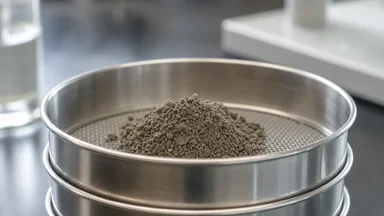
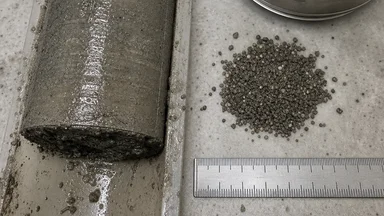
The first lab, at Stockholm University, used a standard 63-micrometer sieve to separate silt from sand. Particles passing through were classified as silt (fine); those retained, as sand (coarse). Their down-core ratio of coarse to fine material showed a pronounced minimum at roughly 4 meters depth, which they interpreted as a prolonged cool phase.
The second lab, at Lund University, used the same nominal cut—63 micrometers—but with a different pretreatment. They first treated the sediment with hydrogen peroxide to remove organic matter, then wet-sieved. In their samples, the coarse fraction peaked at the same depth, implying increased runoff and a warm, dry climate.
When the two groups compared notes at a conference, the discrepancy became a puzzle. Each had followed published protocols. Each had replicated their own results. The answer, it turned out, lay in how the 63-micrometer boundary interacted with the mineralogy of the sediment.
Why 63 Micrometers Matters
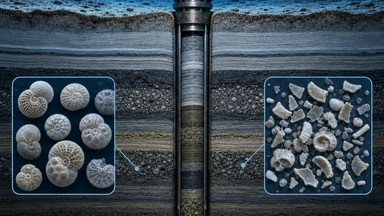
The 63-micrometer cut is one of the oldest conventions in sedimentology. It marks the division between silt and sand in the Wentworth scale, adopted in the 1920s and still used today. But a micrometer is a small unit—roughly one-hundredth the width of a human hair. A shift of just a few micrometers can change which mineral grains fall on either side of the boundary. In Lake Bysjön, the sediment contained abundant quartz grains in the 60–70 micrometer range, alongside platy clay minerals that aggregated into particles larger than 63 micrometers. The peroxide treatment used by the Lund group broke apart organic-bound aggregates, releasing clay clumps that then passed through the sieve as silt. The Stockholm group, which did not use peroxide, retained those clay aggregates as sand-sized particles. The effect was systematic. In the peroxide-treated samples, the coarse fraction was dominated by quartz, a mineral that resists chemical weathering and is often associated with physical erosion during wet periods. In the untreated samples, the coarse fraction included both quartz and clay aggregates, diluting the erosion signal. The result was that the same sediment layer appeared coarse in one lab and fine in the other. This is not a story about error. Both labs performed competent work. The issue is that the grain-size cut is not a neutral window; it is an active filter that selects which minerals count as “coarse.” And because different minerals carry different environmental meanings, the cut itself becomes part of the interpretation.
Lab Procedures That Hide Variation
Sedimentologist Maria Lindgren, who led the Stockholm group, described the problem in a 2019 methodology paper: “We found that simply changing the pretreatment step—adding or omitting peroxide—shifted the apparent grain-size mode by roughly 5 to 10 micrometers in some samples.” Her team later ran a controlled experiment using a reference sediment from Lake Bysjön, distributing it to six labs across Europe.
The results, published in Journal of Paleolimnology, showed that the coarse fraction varied by up to 12 percentage points across labs, even when all reported using a 63-micrometer sieve. The main sources of variation were pretreatment (peroxide vs. no peroxide), sieving duration, and whether the sample was dried before sieving.
One lab, which used ultrasonic dispersal before sieving, reported a coarse fraction nearly twice that of another lab that simply wet-sieved. The ultrasonic treatment broke apart weakly bound aggregates, releasing fine particles that would otherwise have been counted as coarse. The lab without sonication retained those aggregates, inflating the coarse fraction.
These differences are not trivial. A 10-percentage-point shift in the coarse fraction can alter the reconstructed temperature curve by 1 to 2 degrees Celsius, enough to change whether a period is classified as a “warm anomaly” or “within normal variability.” For paleoclimate studies that feed into climate model validation, such shifts matter.
The problem is compounded by publication norms. Most paleolimnology papers report only the final grain-size index—typically the percentage of particles above 63 micrometers—without detailing the exact protocol. A reader cannot tell whether a given result depends on a particular pretreatment or sieving time. As of late 2024, fewer than one in four paleoclimate studies that use grain-size data report their full pretreatment protocol in a supplementary file.
A Worked Example: Lake Bysjön
Lake Bysjön lies in the boreal forest of central Sweden, about 200 kilometers northwest of Stockholm. Its sediments span the Holocene, the roughly 11,700-year period since the last ice age. The lake is small—about 0.3 square kilometers—and relatively deep, with a maximum depth of roughly 12 meters. Its sediments are laminated in places, offering a high-resolution record of environmental change.
The original grain-size study at Stockholm used a 63-micrometer sieve after deflocculating the sediment with sodium hexametaphosphate, a common dispersant. The researchers reported a gradual coarsening upward from about 6,000 years ago, which they interpreted as increasing human land use—forest clearance and agriculture—rather than climate change.
When the Lund group reanalyzed the same core, they used hydrogen peroxide to remove organics, followed by wet sieving at 63 micrometers. Their coarse fraction showed a sharp peak at roughly 4,000 years ago, which they attributed to a dry, windy period that increased erosion of surrounding soils. The two interpretations were not compatible: one called for human activity, the other for climate.
A third team, from Uppsala University, eventually reanalyzed both datasets using laser diffraction, which measures the full particle-size distribution without sieving. They found that the actual grain-size mode at the disputed depth was roughly 58 micrometers—just below the 63-micrometer cut. Small changes in the cut, they showed, could move the mode from one side to the other.
The Uppsala team’s reconstruction, published in 2021, suggested that the 4,000-year interval was neither exceptionally cool nor exceptionally warm, but rather a period of high interannual variability. The temperature curve shifted by roughly 2 degrees Celsius depending on which grain-size index was used—a spread that encompassed both earlier interpretations.
The Lake Bysjön case is not unique. Similar discrepancies have been documented in sediment cores from Lake Challa in East Africa, from the Black Sea, and from several European lakes. In each case, the choice of grain-size cut or pretreatment altered the climate signal enough to change the narrative.
How the Field Is Standardising
In response to cases like Lake Bysjön, the International Paleolimnology Association (IPA) issued a set of best-practice guidelines in 2022. The guidelines recommend that researchers report the full particle-size distribution—not just the percentage above or below a single cut—and that they archive raw data in a public repository. The hope is that future reanalyses can test whether a result depends on a particular boundary.
Laser diffraction, which measures particles in dozens of size classes simultaneously, is increasingly replacing sieving in many labs. Instruments such as the Malvern Mastersizer can resolve differences of less than a micrometer, making the 63-micrometer cut less arbitrary. But laser diffraction has its own methodological choices: the optical model used to convert light scattering to particle size, the refractive index assumed for the sediment, and the way aggregates are dispersed before measurement.
As of early 2025, roughly half of new paleolimnology studies use laser diffraction, but the other half still rely on sieving. Many legacy datasets—including those used in global compilations of Holocene temperature—are based on sieve cuts. Recalibrating those records to a common standard is an ongoing effort, but it is complicated by the fact that raw grain-size data were rarely archived before 2010.
Some researchers advocate for a Bayesian approach that treats the grain-size cut as a parameter rather than a fixed threshold. In this framework, the cut is allowed to vary within a plausible range, and the reconstruction is weighted by how sensitive it is to that choice. A 2024 preprint from the University of Bern applied this method to a set of European lake cores and found that about one-third of published temperature anomalies were sensitive to the cut at the 1-degree level.
Practical Takeaways for Paleo Researchers
For researchers working with sediment grain size, the Lake Bysjön story offers several concrete lessons. First, archive the raw grain-size distribution—not just the derived index. A histogram of particle sizes allows future researchers to test alternative cuts. Several journals now require this as a condition of publication, but enforcement is uneven.
Second, report pretreatment steps in full, including the type and concentration of dispersant, the duration of sieving, and whether the sample was dried or kept wet. A 2023 survey of 40 paleolimnology papers found that fewer than half reported the sieving time, even though it can affect the result by several percentage points.
Third, run cross-lab calibration exercises on reference sediment. The Lake Bysjön reference material, distributed by Lindgren’s group, is now used by roughly a dozen labs as a quality check. Similar reference materials exist for marine sediments but are less common for lake deposits.
Fourth, use multiple grain-size indices rather than relying on a single cut. The ratio of silt to clay, the median grain size, and the sorting coefficient each capture different aspects of the depositional environment. When they agree, the signal is robust; when they disagree, the interpretation should be treated with caution.
Finally, consider modeling the grain-size cut as a source of uncertainty. Bayesian hierarchical models that include the cut as a parameter can propagate this uncertainty into the final temperature reconstruction. A 2022 study from the University of Helsinki showed that doing so widened confidence intervals by roughly 30 percent on average, but also reduced the rate of false climate anomalies.
These steps are not burdensome. They require modest additional lab time and a willingness to share raw data. But they can prevent the kind of contradictory reconstructions that erode confidence in paleoclimate science.
When a Micrometer Rewrites History
The Lake Bysjön case is a reminder that scientific results are not just products of nature; they are also products of procedure. A 2-micrometer shift in a sieve cut—too small to see without a microscope—can flip a cool period into a warm one, or a human signal into a climate signal. For paleoclimate reconstructions that feed into policy-relevant assessments, such as the IPCC reports, the stakes are real.
Climate modelers rely on paleoclimate data to test whether their models can reproduce past warm periods. If the paleodata themselves are sensitive to arbitrary cuts, then model validation becomes circular: a model tuned to one reconstruction may fail when tested against another, without either being wrong in a straightforward sense.
This does not mean that paleoclimate science is broken. It means that the field is maturing. The recognition that small procedural choices matter is a sign of methodological sophistication, not failure. The same kind of introspection has happened in other fields—for example, in psychology, where funding gaps drive variation in replication outcomes, and in particle physics, where data cuts flip measurements.
What matters is transparency. As sedimentologist Maria Lindgren put it in an interview: “We should not be embarrassed that our results depend on method. We should be embarrassed if we hide that dependence.” The goal is not to eliminate procedural variation—that is impossible—but to document it so that others can assess how much it matters.
Looking ahead, the field must continue to develop standardized reference materials and encourage open data practices. The Lake Bysjön case should serve as a cautionary tale, not a source of despair. By embracing methodological transparency, paleoclimate science can strengthen its foundations and provide more robust evidence for understanding Earth's past climate.