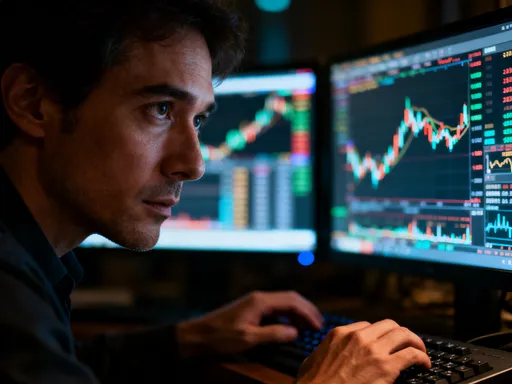
My Broker Kept My $14,000 Commission While My Trade Crashed
Imagine walking into a car dealership, buying a vehicle for $24,000, and then watching it get towed away an hour later—while the dealer keeps your $14,000 down payment. That's essentially what happened to a retail investor I'll call Dan, who placed a complex options trade through a major online broker. The trade cratered within days, leaving his position worthless. But the broker had already deducted a $14,000 commission. Dan was left with nothing but a lesson in how the system is stacked against small traders.
The $14,000 Fee That Vanished Into Thin Air
Dan's story isn't unique. He bought a package of exotic options—a strategy he'd read about on a trading forum—that promised leveraged exposure to a volatile stock. The trade went south almost immediately, and within a week the options expired worthless. Dan lost his entire principal of $50,000. But what stung most was the $14,000 commission the broker had taken upfront. That fee was equal to the equity in a car, as defined in finance—the difference between an asset's value and any debt against it. In Dan's case, the fee alone could have bought a used sedan.
When Dan contacted the broker's customer service, he was told the commission was non-refundable. The broker had executed the trade as requested, and the outcome was Dan's responsibility. There was no recourse. The fee was gone, and the broker's fiduciary duty—the legal obligation to act in the client's best interest—was never triggered because the broker operated on a commission basis, not as a fiduciary.
This scenario plays out thousands of times a day in the U.S. retail brokerage industry. While most trades are small and cheap, exotic products like options, futures, and leveraged ETFs carry hidden charges that can dwarf the trade's potential profit. And when the trade fails, the broker still gets paid.
How Commission Structures Hide the Conflict
The typical retail commission for a stock trade is near $10 per trade at full-service brokers, and many discount brokers now offer zero-commission trading. But zero-commission doesn't mean zero cost. Brokers make money through payment for order flow—selling your trade data to high-frequency trading firms—and through fees on more complex products. Options trades, for example, often carry a per-contract fee of $0.65 to $1.00, which can add up quickly. A multi-leg strategy like an iron condor might involve four contracts per spread, and a trader executing dozens of spreads a month can easily rack up hundreds in fees.
The conflict is front-loaded: the broker earns the fee at the moment of execution, regardless of whether the trade succeeds or fails. This creates a perverse incentive to encourage trading volume, not profitable outcomes. A 2021 study from the Securities and Exchange Commission (SEC) found that brokers who receive higher payment for order flow tend to execute trades at slightly worse prices for their clients—a hidden cost that compounds the explicit fee.
Some brokerages have moved to a subscription model, charging a flat monthly fee for unlimited trades. But even these models often exclude options and futures, or charge additional per-contract fees. The net effect is that retail investors pay a significant amount for the privilege of trading, and the broker's interest and the client's interest are not aligned.
A Real-World Case: The GME Debacle of 2021
The GameStop (GME) frenzy of early 2021 revealed how fragile the retail trading ecosystem is. As the stock price soared, Robinhood and other brokers suddenly restricted buying, citing collateral requirements from their clearinghouses. Users who had bought call options or held leveraged positions were unable to exit or adjust their trades. Many lost thousands of dollars they could not recover.
Robinhood faced a $70 million fine from the Financial Industry Regulatory Authority (FINRA) for misleading communications and system failures, but the firm admitted no fault. The fine was a fraction of the revenue Robinhood generated from payment for order flow during the same period—roughly $330 million in the first quarter of 2021 alone. For the average user, the fine meant nothing. Their losses were real, and the commissions and fees they paid during the frenzy were non-refundable.
The incident highlighted a systemic problem: when volatility spikes, brokers prioritize their own risk management over client interests. They can halt trading, widen spreads, or even liquidate positions without warning. The fine print in account agreements allows this, and the fees are already pocketed. It's a double hit—you lose on the trade, and you lose the fee.
The Fine Print That Binds You
Every brokerage account agreement contains an arbitration clause. By signing up, you waive your right to sue in court. Instead, any dispute must go through FINRA arbitration, a process that critics say favors the industry. According to a 2020 report from the Public Investor Advocate Bar Association, investors won less than 2% of arbitration cases that went to a hearing. The odds are worse than winning at blackjack.
Even if you have a strong case—say, the broker executed a trade without your authorization or charged a fee not disclosed in the fine print—the cost of arbitration can be prohibitive. Filing fees, attorney fees, and expert witness costs can easily exceed $14,000. For a small investor, it's simply not worth fighting. The broker knows this and counts on it.
Dan's account agreement, like most, included a clause that said the broker could change terms at any time with 30 days' notice. It also said the broker was not liable for losses caused by system errors, market volatility, or even their own negligence. These clauses are standard. They are designed to protect the broker, not the client. And they are rarely challenged successfully.
Why Regulators Have Not Fixed This
The SEC has the authority to regulate broker fees and require that they be reasonable. But enforcement is underfunded. As of late 2024, the SEC's budget was roughly $2 billion, a fraction of the financial industry's lobbying spending. The brokerage industry spent over $100 million on lobbying in 2023 alone, according to OpenSecrets.org. That money buys influence over rulemaking and enforcement priorities.
The SEC did adopt a new "best interest" standard in 2019, requiring brokers to act in the client's best interest when recommending investments. But the rule has loopholes. It doesn't apply to unsolicited trades—the kind Dan placed himself. And it doesn't require brokers to refund fees on losing trades. The standard is also vague, leaving room for interpretation. A 2022 study by the Consumer Federation of America found that many brokers still recommend high-fee products when a lower-cost alternative exists.
State-level suits have attempted to close these gaps. California and New York have pursued actions against brokers for unfair practices, but the results are slow and uneven. A single state victory might change rules in that jurisdiction, but brokers can still operate differently elsewhere. Until federal rules are tightened, the status quo remains.
Three Steps to Protect Your Next Trade
You don't have to be a victim of the fee structure. Here are three concrete steps to reduce your risk.
First, use a fee-only fiduciary advisor. A fee-only advisor charges a percentage of assets under management or a flat retainer, not a per-trade commission. This aligns their interest with yours: they only make money when your portfolio grows. You can find vetted advisors through the National Association of Personal Financial Advisors (NAPFA).
Second, avoid brokers with per-trade commissions. If you trade actively, look for a broker that offers a flat monthly fee for unlimited trades, and check whether that fee covers options and futures. Read the account agreement before you fund it. Look for the arbitration clause and consider whether you're comfortable with it. If not, some firms offer court-based dispute resolution, though they are rare.
Third, set stop-loss orders to limit damage. A stop-loss order automatically sells a position if it drops to a certain price. This won't protect you from the fee, but it will prevent a catastrophic loss that makes the fee seem even more painful. In Dan's case, a stop-loss might have saved him from losing the entire $50,000 principal, even if the $14,000 fee was gone.
Also, check your broker's disciplinary history on FINRA's BrokerCheck website. A pattern of complaints is a red flag. And remember: the cheapest broker isn't always the best. Sometimes paying a slightly higher fee for a fiduciary relationship is worth it.
Trade-Offs: Low Fees vs. Quality Execution
One common counter-argument is that low-cost brokers have democratized trading, allowing millions of people to participate in markets who otherwise couldn't afford it. Zero-commission trading has indeed lowered barriers. But the trade-off is often hidden. A broker that offers free trades may route orders to market makers that pay for order flow, resulting in slightly worse prices. Over many trades, this price deterioration can exceed what you would have paid in explicit commissions.
For example, a study by the SEC found that payment for order flow costs retail investors about 0.5 cents per share in worse execution. If you trade 1,000 shares per month, that's $5.00 in hidden costs—more than many brokers' explicit commissions. Worse, these costs are invisible, so investors don't shop around for better execution. Meanwhile, the broker pockets the payment for order flow and the client gets a raw deal.
Another trade-off is between convenience and cost. Many brokers now offer mobile apps with easy one-click trading. But that ease can encourage overtrading, which multiplies fees. A 2020 study from the University of California found that users of trading apps trade 40% more frequently after downloading the app, and their returns suffer as a result. The broker benefits from higher volume, while the client's net performance declines.
Investors must weigh these trade-offs carefully. A broker that charges a modest commission but provides better execution and fiduciary oversight may be cheaper in the long run than a zero-commission broker that sells order flow and offers no advice.
Real-World Examples of Fee Disasters
Dan's case is not isolated. Consider Sarah, a retiree who invested $200,000 in a leveraged ETF through a full-service broker. The broker charged a 1% upfront commission—$2,000—and an annual expense ratio of 1.5% on the fund. Within two years, the fund lost 60% due to volatility decay, and Sarah's investment was worth $80,000. She had paid $2,000 in commission plus ongoing fees, and the broker refused to refund any of it. Sarah's story shows that even with a full-service broker, the fee structure can be devastating.
Another example is Mike, a day trader who executed 500 options contracts per month. His broker charged $0.70 per contract, so Mike paid $350 per month in commissions. Over a year, that's $4,200—more than the profit he made from trading. When he complained, the broker pointed to the fee schedule he had agreed to. Mike's experience illustrates how small per-contract fees can snowball into a significant drag on returns.
These examples underscore the importance of understanding fee structures before trading. A single bad trade can wipe out months of gains, and the broker's fee is the first cost you incur.
Counter-Argument: Are Commissions Justified?
Some argue that commissions are a fair price for the service of executing a trade. After all, brokers provide technology, order routing, and customer support. Without commissions, these services would have to be funded elsewhere—perhaps through higher account minimums or subscription fees. Moreover, brokers take on risk: if a client fails to pay for a trade, the broker may be liable. From this perspective, a non-refundable commission is simply the cost of doing business.
However, this argument overlooks the asymmetry of information and power. Brokers know exactly what fees they charge and how they affect returns, while many retail investors do not. The complexity of fee structures—per-contract fees, payment for order flow, margin interest, and more—makes it nearly impossible for the average person to compare costs across brokers. A fair system would require full, simple disclosure of all costs and their impact on portfolio performance. Until that happens, commissions remain a hidden tax on retail investors.
Furthermore, the argument that commissions are necessary for broker profitability is undermined by the fact that many brokers now offer zero-commission trading and still make billions through payment for order flow and other revenue streams. This suggests that explicit commissions are not essential; they are simply a way to extract additional profit from less informed clients.
Looking Ahead: Potential Reforms
Several reforms could address the commission conflict. One idea is to require brokers to refund a portion of the commission if a trade loses money within a certain period, say 30 days. This would align the broker's incentive with the client's outcome. Another proposal is to ban payment for order flow, forcing brokers to charge explicit fees that are visible to clients. The SEC has considered both ideas, but industry opposition has stalled progress.
Another approach is to strengthen the fiduciary standard. Currently, brokers only have to act in the client's best interest when making recommendations. Expanding this duty to all trades—including unsolicited ones—would force brokers to consider whether a trade is appropriate before executing it. This could reduce the number of bad trades and the fees that go with them.
Finally, increased transparency around arbitration could help. If investors knew how low their chances of winning are, they might push for change. Some have called for a public database of arbitration outcomes, making it easier to identify problematic brokers. Until these reforms happen, investors must rely on their own vigilance.
Disclaimer: This article is for informational purposes only and does not constitute personalized financial advice. Consult a qualified professional before making investment decisions.