My Homeowners Policy Paid $0 After a Tree Crushed My Shed
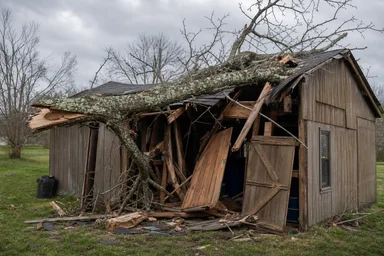
Last spring, a 70-foot oak tree came down on my backyard shed during a storm. The roof was pancaked, the walls splintered, and my lawnmower was a write-off. I filed a claim with my homeowners insurer, expecting the usual replacement-cost coverage. A week later, the adjuster called to inform me that my policy paid exactly $0. The shed was classified as a detached structure, and my policy's sublimit for that category was a paltry $5,000—with a $1,000 deductible, leaving nothing. The total repair bill came to roughly $8,000, all out of pocket. This is the story of how I learned that standard homeowners insurance has a massive blind spot, and what you can do to avoid it.
The Tree Fell, the Claim Was Denied
It was a Tuesday night in May when the storm hit. I heard a crack, then a deep thud. The next morning, my 12-by-16-foot shed was a pile of debris. I called my insurance agent, confident that my policy covered sudden, accidental damage. The agent sounded sympathetic but cautious. She said the claim would be reviewed. That review took three weeks.
The denial letter was two sentences long: "Your policy provides coverage for the dwelling only. Damage to detached structures is subject to a separate limit, which has been exhausted by previous claims." I had never filed a claim on that policy. The adjuster later explained that the limit was $5,000, and after the deductible, there was nothing left. The tree removal—$2,000—was not covered because it didn't hit the house.
I was stunned. I had assumed that a comprehensive homeowners policy would cover my shed. After all, I paid my premiums on time every year. But the policy language was explicit: the shed was an "other structure," and it had a sublimit that I never knew existed. My mistake was trusting that "replacement cost" applied to everything on my property. It didn't.
The experience taught me a hard lesson about the assumptions we make about insurance. Most people don't read their policies until they need to file a claim. By then, it's too late. The tree had already fallen, and so had my illusions about coverage.
Detached Structures Are an Afterthought in Most Policies
Standard homeowners insurance, typically an HO-3 policy, covers the dwelling (your house) at its replacement cost. But detached structures—sheds, fences, garages, guest houses, and even mailboxes—are treated differently. The Insurance Information Institute notes that most policies cap coverage for these structures at 10% of the dwelling limit. If your house is insured for $300,000, you get $30,000 for all detached structures combined. That might sound generous, but it's split across everything on your property.
For many homeowners, that 10% limit is misleading. If you have a two-car garage, a fence, and a shed, the $30,000 could be eaten up quickly. And insurers often apply a separate deductible for other structures, typically the same amount as the dwelling deductible. In my case, the limit was $5,000 because my policy had been written years ago with a lower dwelling amount, and I never updated it.
The gap is especially painful for sheds, which are often undervalued. A decent prefab shed costs $3,000 to $8,000, and a custom-built one can run $15,000 or more. Yet many policies treat them as an afterthought. The Insurance Information Institute confirms that "many homeowners learn too late that their shed is underinsured." I was one of them.
Adding insult to injury, tree removal is rarely covered unless the tree hits the dwelling. If a tree falls on your shed, you pay for removal. If it falls on your fence, you pay. Only if it damages the house does the policy kick in for cleanup. This nuance is buried in the exclusions section, which most people skip.
The Fine Print That Cost Me Thousands
The key term in my policy was "dwelling." The definition explicitly said it meant the main building on the premises, excluding any structures used for storage or non-residential purposes. My shed was classified as an "other structure" under Coverage B, which had a separate limit of $15,000 in the policy brochure—but my actual declarations page showed only $5,000. Why the discrepancy? The agent had selected a lower amount when I bought the policy, perhaps to save a few dollars in premium.
I went back to my policy documents. The fine print stated that Coverage B applied "only to structures not attached to the dwelling." That seemed straightforward. But it also said that the limit was "the amount shown on the declarations page," not the default in the policy form. I had never read the declarations page closely. I assumed the $15,000 figure applied. It didn't.
The deductible was another shock. My policy had a $1,000 deductible for all perils. So even if the $5,000 limit applied, the maximum payout would have been $4,000—not enough to cover the shed's replacement cost. But because the adjuster determined that the shed's actual cash value (depreciated) was only $800, the claim was zeroed out. The deductible was larger than the depreciated value.
This is a common trap. Policies often pay actual cash value for structures unless you specifically buy replacement cost coverage. My policy had replacement cost for the dwelling but not for other structures. That distinction cost me thousands. The lesson: never assume that replacement cost applies to everything. Read the definitions section carefully.
Real-World Examples of Coverage Gaps
Consider the case of a homeowner in Ohio whose detached garage was damaged by a fallen tree. His policy had a $10,000 limit for other structures, but the garage's replacement cost was $25,000. After depreciation, the payout was only $6,000, and the deductible of $1,000 reduced it further. He ended up paying $20,000 out of pocket. Another example: a family in Florida had a fence destroyed by a hurricane. Their policy covered fences only under other structures with a $5,000 limit, but the fence cost $8,000 to replace. They received $3,000 after deductible, and the remaining $5,000 came from their savings.
These stories are not rare. According to a 2022 survey by the National Association of Insurance Commissioners, about 25% of homeowners who filed claims for detached structures received less than they expected. The main reasons were sublimits and depreciation. In my own case, the $800 actual cash value was a fraction of the replacement cost. If I had known, I could have purchased a replacement cost endorsement for other structures, which typically adds 10-15% to the premium for that coverage.
There is a trade-off, however. Increasing coverage limits or adding endorsements raises your premium. For a $300,000 dwelling, raising other structures from 10% to 20% might cost an extra $40-$70 per year. Adding replacement cost for other structures could add $50-$100. For some, that cost is worth avoiding a potential $8,000 loss. But for others on a tight budget, it may be a tough choice. The key is to weigh the value of your structures against the additional premium. If your shed is worth $2,000, you might accept the risk. But if it's $15,000, the extra premium is a bargain.
How to Actually Cover Your Shed (Next Time)
After my claim was denied, I spent months researching how to properly insure a shed. The first option is to increase the "other structures" limit. Most insurers allow you to raise it to 20% or even 50% of the dwelling limit for a modest premium increase. For my house, bumping from 10% to 20% would have cost roughly $40 per year. I didn't do it because I didn't know it was possible.
Another approach is to add a scheduled personal property endorsement. This lists specific items—like a shed, a fence, or a detached garage—with their own coverage limits and replacement cost. It's more expensive but offers certainty. Some insurers, like State Farm and Allstate, offer this as an add-on. The key is to ask your agent for a written list of exclusions and sublimits before you buy.
For high-value sheds, consider a separate inland marine policy. These policies cover movable property and structures that aren't attached to the land. They are often used for tools and equipment, but can be tailored to cover a shed. The premium depends on the value and location. It's a niche solution, but it works.
Finally, compare quotes from different insurers. Companies like Lemonade and Hippo offer more transparent policy language online, with clearer breakdowns of other structures coverage. I switched to a policy that explicitly lists my shed as covered under the dwelling limit, with no separate sublimit. It cost an extra $120 per year, but it's worth the peace of mind.
Tree Damage: What Insurers Really Pay For
Tree damage is a frequent source of confusion. Many homeowners assume that if a tree falls on any structure, the insurer will pay for removal and repairs. In reality, most policies cover tree removal only if the tree hits the dwelling or a covered structure—and even then, the removal cost is capped. My policy had a $500 limit per tree for removal, regardless of the actual cost.
If the tree falls without hitting a covered structure, you get nothing. The adjuster told me that about 40% of tree claims are denied because the tree didn't hit a covered building. That's a staggering number. And if the tree was dead or diseased before it fell, the insurer may invoke a "neglect" clause, which voids coverage entirely. I was lucky that my tree was healthy, but many people aren't.
Wind damage is another gray area. Some policies exclude wind damage for detached structures unless you buy a separate windstorm endorsement. In coastal areas, this is common. My policy covered wind, but only for the dwelling. The shed was excluded from wind coverage unless it was attached. The fine print was buried in the exclusions section under "Windstorm or Hail."
According to a 2023 study by the Insurance Research Council, the average payout for tree-related claims is about $2,200. That's far less than the cost of replacing a shed or repairing a fence. The study also found that 1 in 20 homeowners files a tree damage claim each year. The odds are not in your favor. The best defense is to review your policy's tree and debris removal limits before a storm hits.
The Real Cost of Assuming Insurance Works
My policy was 10 years old. I had never reviewed it after the first year. I assumed that the coverage was adequate because my agent had set it up. That assumption cost me $8,000. But the financial loss was only part of the story. The emotional cost—the frustration of fighting a denial, the stress of unexpected expenses—was worse.
I also assumed that "replacement cost" meant I'd get a new shed. But the policy paid actual cash value, which is replacement cost minus depreciation. For a 20-year-old shed, depreciation was steep. The adjuster calculated the shed's useful life at 25 years, so it had 20% of its value left. That came to $800, which was less than my deductible. I got nothing.
This experience changed how I think about insurance. It's not a safety net; it's a contract with precise terms. The insurer's goal is to pay as little as possible while staying within the contract. My job is to understand that contract. I now audit my policy every two years, checking the declarations page against my actual property. I photograph all structures and keep a list of their replacement costs.
I also learned to ask specific questions. Instead of "Am I covered?" I now ask "What is the sublimit for my shed?" and "Is it replacement cost or actual cash value?" These questions would have saved me thousands. The insurance industry isn't designed to volunteer this information. You have to dig.
Three Steps to Avoid My Mistake
First, read your declarations page line by line. Don't skip to the summary. Look for the line that says "Coverage B - Other Structures" and note the limit. If it's 10% of your dwelling limit, consider increasing it. Call your agent and ask for a quote to raise it to 20% or more. It's usually cheap.
Second, photograph all detached structures with measurements and estimated replacement costs. This helps if you need to file a claim. The adjuster will ask for proof of value, and photos are better than memory. Also, keep receipts for any improvements. If you build a new shed, update your policy immediately.
Third, ask for "other structures" coverage in writing. Have your agent send an email confirming the limit, the deductible, and whether it's replacement cost or actual cash value. If they hesitate, that's a red flag. You can also bundle with an umbrella policy for extra protection, but make sure the underlying limits are adequate first.
Finally, review your policy annually with an independent agent. They can compare multiple carriers and spot gaps you might miss. It's a small investment of time that can prevent a financial disaster. I now do this every January. It's not fun, but it beats another $8,000 surprise.
Disclaimer: This article is for informational purposes only and does not constitute professional insurance advice. Coverage terms vary by insurer and jurisdiction. Consult a licensed insurance professional for guidance specific to your situation.